
How to store cigars without a humidor
Short answer: For a few cigars or a short stretch, use a clean, odor-free container that closes well, add properly sized cigar humidity control, and keep it in a stable, cool indoor place. A zip-close bag is a stopgap; a sealed plastic or glass container is more dependable. Cellophane, a cigar box, and a refrigerator are not humidity-control systems.
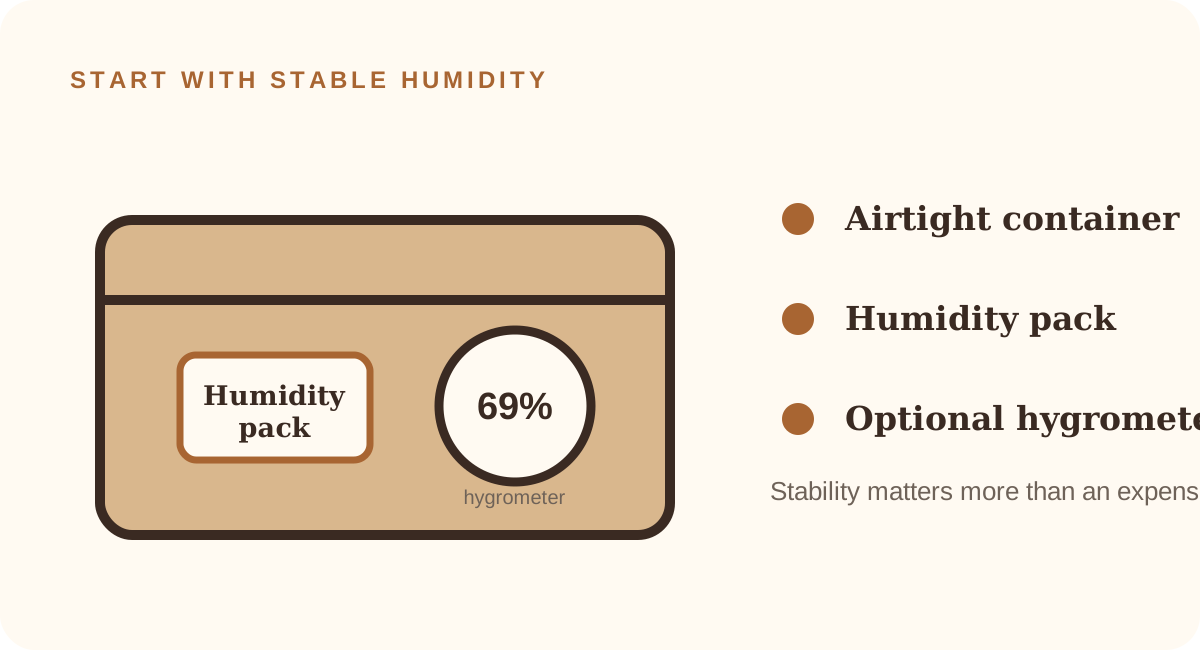
What a humidor does, and what your substitute must do
A humidor is simply a controlled storage environment. The box itself is not the important part. Your substitute needs three things: a reasonably good seal, suitable humidity control, and a location away from heat and large swings in temperature. Tobacco University notes that stability matters as much as a target number; repeated humidity changes make cigars absorb and release moisture.
For a baseline on humidity and temperature, read our humidor basics guide. This page is for the period before you own a humidor, for overflow, or for a modest temporary stash. It is not a claim that every container is equally good for indefinite storage.
Choose the simplest container that closes well
For one or several cigars, a sturdy cigar-storage bag made for humidity control is the simplest option. In a pinch, a clean zip-close food bag can protect cigars from handling and slow moisture loss, but it is less durable and less sealed than a purpose-made bag.
For a small group of cigars, use a clean food-safe plastic or glass container with a close-fitting lid. It should be empty of food odors, perfumes, cleaning residue, and loose debris. A small cooler can work for more capacity, but size alone does not make it a humidor: it still needs the right humidity source and sensible monitoring.
| Situation | Reasonable setup | What to watch |
|---|---|---|
| A few days | Shop bag or clean zip-close bag, kept indoors | Keep it closed and away from heat; do not assume cellophane is enough. |
| More than a few days | Sealed container or purpose-made humidor bag with cigar humidity control | Match the humidity-control product to the container and cigar quantity. |
| Growing collection | Dedicated sealed storage or a maintained humidor | Space, seal quality, stable conditions, and an accurate hygrometer matter. |
Use a purpose-made humidity-control product
The low-maintenance choice is a cigar humidity-control pack designed to hold a stated relative-humidity range. Follow its capacity and replacement guidance rather than guessing from the size of the package. Boveda and other makers publish container-specific capacity instructions; a pack meant for a larger space may be excessive in a tiny container, while an undersized pack may be exhausted quickly.
Do not place a wet sponge, paper towel, or open cup of water directly with cigars. Those methods make humidity hard to predict, can create wet spots, and introduce avoidable mold risk. Direct water is not a substitute for controlled humidity.
Keep the container cool and stable
Store the container in a normal, stable indoor space, out of direct sun and away from heaters, cars, garages, and hot windows. Cigar-storage guidance commonly treats roughly 65–70% RH as a workable starting range, while Tobacco University advises keeping storage below 72°F when possible. The practical lesson is not to chase a single number; it is to avoid heat and abrupt changes.
Do not put cigars in a refrigerator or freezer as ordinary storage. Cold appliances are not a simple humidor replacement, and moving cigars between very different conditions can create problems of its own.
What does not keep cigars fresh on its own
Cellophane
Cellophane protects a wrapper from handling and abrasion, especially when traveling, but it is porous. It does not supply or hold the humidity a cigar needs once it is out of controlled storage. Keeping it on can still be sensible for protection; just put the cigar in a properly prepared storage environment.
A cigar box
A presentation box can protect cigars from bumps, but it is not automatically sealed or humidified. Put the box inside a suitable larger container if you need it to hold conditions.
A travel case
A travel case is useful when movement and impact are the main problem. For a trip, see how to travel with cigars. For stationary temporary storage, choose the setup based on its seal and humidity-control capacity rather than its appearance.
When it is time to upgrade
Move to a dedicated, maintained storage solution when you are opening the temporary container constantly, the collection no longer fits without crowding, the humidity-control product is hard to size, or you want dependable long-term storage. A well-sealed plastic container with appropriate control can be practical, but a permanent collection deserves a setup you can monitor and maintain deliberately.
If cigars already feel brittle, split, unusually soft, or repeatedly burn poorly, avoid dramatic corrections. Return them to stable conditions and let them acclimate gradually. Our humidor troubleshooting section explains what those clues can and cannot tell you.
A five-minute setup
- Choose a clean, odor-free container that closes fully.
- Keep the cigars protected from rubbing or pressure; cellophane may stay on for handling protection.
- Add humidity control sized for the container and follow the maker’s instructions.
- Close the container and place it in a stable indoor location away from heat and sun.
- Open it only when needed. If this becomes your regular collection, move to a dedicated setup.
Storage references: Tobacconist University’s cigar-preservation guidance; Holt’s temporary-storage overview; and Boveda’s temporary-storage guidance. These sources support general storage principles; Cigar Path does not recommend a retailer or product.
Cigar Path publishes educational content, not cigar reviews, and does not sell tobacco. Intended for adults of legal tobacco-purchase age.